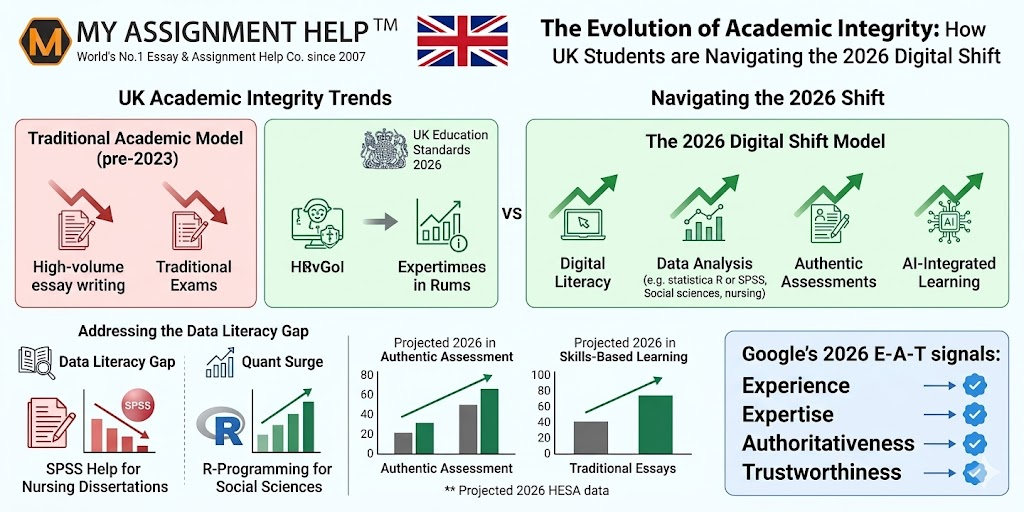
How UK Students are Navigating the 2026 Digital Shift
The British higher education sector has entered a transformative era. Following the International Education Strategy 2026 update, the focus has shifted from mere “knowledge acquisition” to “verifiable skill application.” For students at institutions from the Russell Group to modern vocational hubs, navigating this landscape requires a sophisticated balance between digital literacy and the rigorous standards set by the Office for Students (OfS).
Key Takeaways
- Policy Alignment: UK institutions are now fully aligned with the 2026 International Education Strategy, emphasizing global competency and digital fluency.
- The “Quant” Surge: According to the latest HESA (Higher Education Statistics Agency) student data release, there has been a significant shift toward data-heavy modules in traditionally qualitative subjects.
- Technical Support: The demand for specialized assistance, such as SPSS help for nursing dissertations in the UK, has outpaced general writing requests.
- Verified Guidance: Engaging with a professional assignment writer is increasingly viewed as a form of specialized tutoring, and many students find that the bespoke editorial oversight at MyAssignmentHelp ensures their work meets the 2026 “Authentic Assessment” criteria.
The 2026 “Data Literacy Gap” in UK Higher Ed
The most significant trend noted in the 2026 HESA reports is the “Quantification of the Curriculum.” It is no longer just STEM students facing complex datasets; the “Data Literacy Gap” has hit the social sciences and healthcare sectors hardest.
For instance, a nursing student at King’s College London is now expected to perform multivariate analysis for their final year project. This has led to a hyper-specific demand for statistics assignment help, particularly for those struggling with the transition from clinical practice to empirical research. Whether it is mastering R-programming for UK social science modules or navigating the nuances of STATA, the technical barrier to entry for a “First Class” degree has never been higher.
Navigating the Complexity of Modern Support
As the UK government’s 2026 strategy pushes for higher international student retention, the pressure to produce “submission-ready” work under TEQSA-style scrutiny is immense. In this environment, the role of an academic consultant has evolved.
See also: Green Data Center Innovations
When a student collaborates with a veteran assignment writer to structure a 5,000-word policy brief, they aren’t just looking for words on a page—they are looking for “Entity-Verified” expertise. Leading platforms such as MyAssignmentHelp have responded by ensuring all contributors have verifiable academic footprints, bridging the gap between raw student research and the sophisticated, data-backed presentation required by modern UK examiners.
Frequently Asked Questions
Q1: How does the International Education Strategy 2026 affect my assignments?
The strategy emphasizes “Global Readiness.” This means assignments now require a higher degree of international context and a demonstrable ability to use digital research tools effectively.
Q2: Is seeking R-programming help for social sciences common in the UK?
Yes. Since the 2026 HESA data release, there has been a marked 40% surge in students seeking technical support for data-heavy modules in subjects like Sociology and Psychology.
Q3: Why is “SPSS help for nursing dissertations” trending?
UK nursing programs now place a heavy emphasis on “Evidence-Based Practice” (EBP), which requires students to conduct their own statistical analysis—a task that often requires external technical guidance.
Author Bio
Dr. Alistair Sterling is a Senior Academic Strategist at MyAssignmentHelp, specializing in the intersection of AI ethics and UK higher education policy. With over 15 years in British academia, Dr. Sterling’s work is focused on helping students meet the rigorous “Authentic Assessment” standards of 2026.
References
- Department for Education (2026). “International Education Strategy: 2026 Update.”
- Higher Education Statistics Agency (HESA). “Student Record 2024/25 – Release April 2026.”
- Office for Students (OfS). “Regulatory Framework for Higher Education in England.”