Scale AI Data Annotation Without the Quality Tradeoff
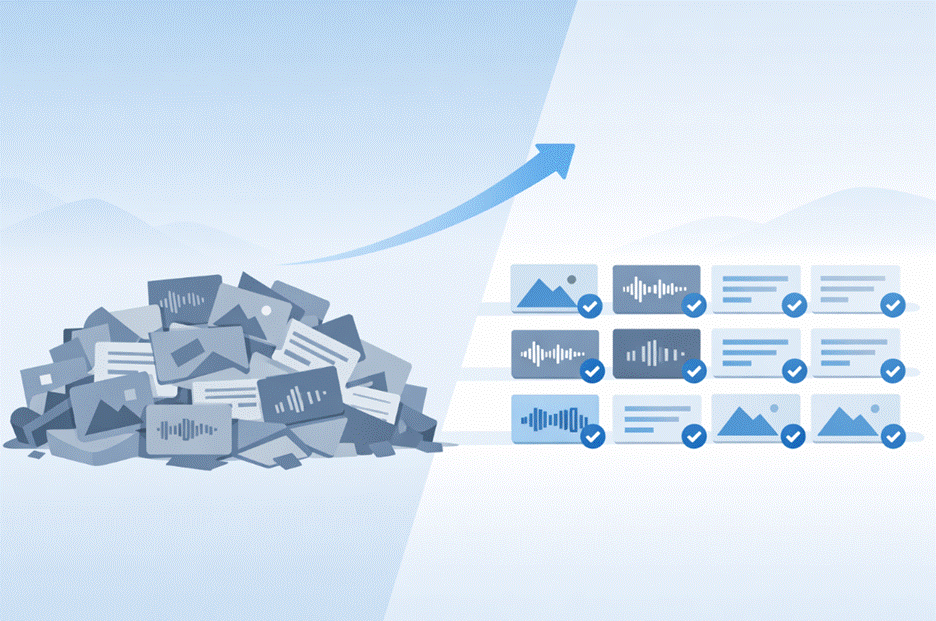
How verified human experts let you grow labeled data volume while accuracy holds steady
| TL;DR Scaling AI data annotation usually breaks quality because teams throw more bodies at the problem instead of fixing the system behind it. The real fix is a purpose-built AI data annotation platform that pairs verified human experts with multi-layer quality control. You ship more labeled data, faster, and your accuracy does not slip. Humyn Labs runs every label through two human checks, so volume stops being a threat to quality. |
| Can you scale AI data annotation without losing quality? Yes. The quality tradeoff comes from manual bottlenecks and inconsistent reviewers, not from scale itself. A modern AI data annotation platform removes both by layering automated pre-labeling, multi-annotator agreement scoring, and expert human review. Accuracy holds steady as your volume climbs. |
Your dataset doubled overnight. The deadline did not move. And the labels came back a mess. If you have lived that exact morning, you are not alone. Most AI teams hit this wall the second they try to grow.
Here is the part teams skip past. A model is only as smart as the data you feed it. Bad AI data annotation does not announce itself. It hides inside your training set, then surfaces later as a model that fails in production. By then, the damage is already baked in.
So teams panic. They hire more annotators. They push harder. And the labels get worse, not better. The old assumption says you pick one: speed or accuracy. I want to take that assumption apart. Scale and quality were never enemies. The broken workflow was the enemy all along. The fix lives inside a smarter AI data annotation platform, and that is what we will walk through here.
Why scaling AI data annotation usually breaks quality
Let us name the problem plainly. When teams scale data labeling, three things tend to snap at the same time.
The hidden tax of low quality labels
A 1% label error sounds harmless. But run that across millions of data points and it compounds fast. Your model learns the wrong pattern, then repeats it with confidence. Industry analysis ties more than 70% of model performance gains to data quality rather than fancy architecture changes. So the labels are not a side detail. They are the main event.
Why headcount alone never fixes the bottleneck
More annotators feels like the obvious answer. It rarely works. Add 50 people to a project and you add 50 readings of the same guideline. One person tags a blurry object as a car. Another calls it a truck. A third skips it entirely. Now your data annotation is inconsistent at scale, and you paid extra for the privilege.
The consistency problem nobody plans for
Reviewer fatigue is real. People get tired. Attention drifts around hour six. And when quality control means spot-checking a random sample, the errors you never sampled still ship. Crowd platforms leave that gap wide open.
Sound familiar? If you have shipped a dataset and prayed it held up, keep reading.
What an AI data annotation platform actually does differently
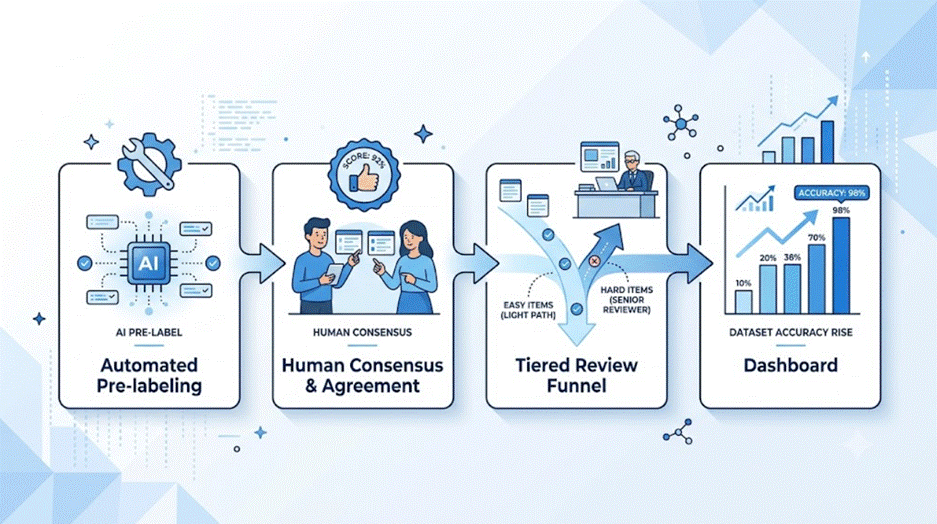
Spreadsheets and ad hoc reviewers do not scale, so a real AI data annotation platform replaces guesswork with a system. Four moving parts do the heavy lifting.
Automated pre-labeling does the heavy lifting first
Modern data annotation tools use pre-trained models to suggest labels before a human touches anything. That clears a big share of the repetitive work up front. Your experts then spend their hours on the hard edge cases, where human judgment actually matters. Automation adoption in annotation now sits near 39% and keeps climbing for exactly this reason.
Consensus scoring protects your accuracy
When more than one expert labels the same item, you can measure agreement, which is just how often your labelers agree. Those scores point straight to where people disagree, and that is usually where your guidelines are fuzzy. Fix the guideline, and quality rises across the whole project. This is how a strong data labeling platform catches drift before it reaches your model.
Human in the loop review that scales with you
Not every label deserves the same scrutiny. Tiered review sends routine items through a light check and routes the tricky ones to senior experts. You get depth where it counts without slowing the whole pipeline. Humyn Labs runs human in the loop AI this way, so coverage stays tight as volume grows.
Quality visibility you can actually see
You need eyes on the work. When you can watch error rates, annotator performance, and agreement metrics in real time, problems surface early. No more finding out at delivery that 8% of your set is wrong. You catch it on day two and fix it.
How to scale without the tradeoff: a practical framework
You know the failure points now. So how do you actually avoid them? Here is the framework you can put to work this week.
- Set your quality bar first. Build a gold standard set and a target accuracy number before you scale a single batch. You cannot protect what you never defined.
- Automate the boring parts. Let pre-labeling handle the repetitive 70%. Reserve your human experts for the edge cases that break models.
- Close the feedback loop. Feed model errors back into your annotation guidelines. Say your model keeps confusing vans with trucks. You tighten that one guideline, and the next batch learns the fix.
- Use tiered review, not blanket review. Check everything lightly, check the hard stuff hard. Spend attention where it changes outcomes.
- Measure continuously. Track agreement and error rates as you go, not just at the finish line. Small corrections beat large rescues.
Follow those five steps and scale stops fighting quality. They start working together.
The business case: what this unlocks for you
A framework is nice, but you need a reason to fund it. Good annotation is not a cost center. It is leverage. Here is what changes when you get it right.
For your ML team: ship faster, babysit less
Clean AI training data means fewer rework cycles and faster model iterations. Your engineers stop firefighting bad labels and start improving models. That is where their time belongs.
See also: The Hidden Advantage Behind Faster Business Decisions
For the business: lower cost per label as you grow
Quality lowers cost at scale, and the math is simple. Rework is expensive. Say a bad batch forces your team to re-label 100,000 items two weeks before launch. That delay costs more than the careful pass would have. Catching errors early kills that rework, and regional specialization in data annotation services has been shown to trim overall project costs by around 20%.
For risk and compliance: defensible data trails
Regulated industries need provenance, a record of who labeled what. When every label carries an audit trail and a verified annotator behind it, you can defend your dataset. That matters in healthcare, finance, and anywhere a regulator might knock.
The market is moving fast, and so should you
A quick look at where the industry sits in 2025 and 2026.
| Metric | Figure | Why it matters |
| Enterprises using annotated data | 54% | Annotation is now mainstream, not niche |
| Performance from data quality | 70%+ | Labels beat architecture for accuracy gains |
| Cost cut from smart workflows | ~20% | Quality and savings move together |
| Projects citing budget limits | 42% | Efficiency is the real constraint to solve |
What to look for in an AI data annotation platform
So you decide to buy rather than build. Use this checklist. A capable AI data annotation platform should give you all of it.
- Multimodal coverage across image, video, text, audio, and sensor data, not one format bolted onto another
- Built in quality control with peer review plus a central QC layer, every label checked rather than sampled
- Verified domain experts with tracked reputation, so a radiologist labels medical scans and a linguist tags speech
- Transparent quality reporting with agreement scores and error breakdowns you can actually read
- Direct access to annotators, no agency markup and no telephone game between you and the work
- Security and clean data handling, because your training data is your competitive edge
Big names like Appen, Scale AI, and Labelbox built the first wave of this market. The gap many of them leave is the anonymous crowd model, where you never know who labeled your data or how. That gap is exactly where verified expertise wins.
How Humyn Labs scales annotation with quality built in
Every problem we just walked through has a fix, and Humyn Labs was built around those fixes. Here is the short version of how.
Every annotator is a verified domain expert, not an anonymous crowd worker. Each one carries a tracked reputation score, so you know real qualifications sit behind your labels. Then every annotation passes two checks. First, peer review by fellow experts. Second, a centralized QC team. Every label is reviewed, not sampled. That is how data annotation services stay accurate even at high volume.
Coverage spans every modality through one pipeline. You can run image segmentation, video tracking, voice data collection, and document labeling without stitching three vendors together. Need paired datasets for foundation models? The data annotation services page lays out formats from COCO and YOLO to fully custom schemas, each delivered with provenance and audit trails.
And if you are weighing options, the team will scope your AI training data project to your volume and timeline, then return a proposal within 48 hours. That is the whole point. You scale, and the quality comes along for the ride.
Frequently asked questions
What is AI data annotation?
AI data annotation is the work of labeling raw data so machine learning models can learn from it. That includes drawing boxes around objects in images, transcribing speech, and tagging sentiment in text. The quality of those labels directly shapes how accurate your model becomes.
How does an AI data annotation platform improve quality?
A platform replaces ad hoc spreadsheets with a system. It adds automated pre-labeling, multi-annotator agreement scoring, and tiered human review. Together these catch errors early and keep labels consistent, even across very large projects.
Can you scale data annotation without losing accuracy?
Yes. Accuracy drops when scaling relies on more bodies and random spot checks. Swap that for double verification and expert review and accuracy holds steady. Volume stops being a threat to quality.
How much does AI data annotation cost at scale?
Cost depends on modality, volume, and complexity. The counterintuitive part is that higher quality often lowers total cost, because catching errors early removes expensive rework. Smart workflows have cut project costs by around 20%.
What types of data can be annotated?
Image, video, text, audio, and sensor data can all be annotated. Strong platforms cover every modality in one place, from bounding boxes and segmentation to speech transcription and entity extraction.
Why is human review still needed with automation?
Automation handles the repetitive labels well, but it stumbles on nuance and edge cases. Human experts catch context a model misses. Pairing the two gives you both speed and judgment, which is the whole idea behind human in the loop.
The takeaway
Scale and quality were never opposites. The old workflow was the problem, and you can replace it. Picture the after state. Your team ships high accuracy labeled data at volume. Your models improve faster. Your costs trend down instead of up. That is not a fantasy. It is what a verified, well-run AI data annotation platform delivers.
Ready to grow your AI training data without watching quality slip? Talk to the Humyn Labs team. Tell them your modality, your volume, and your timeline. You will have a proposal in 48 hours, and confidence in your data soon after.