
The Rules Changed in 2026. Most GLP-1 Microdosing Guides Haven’t Caught Up.
Thirty telehealth companies got FDA warning letters in March 2026. The charge: marketing compounded GLP-1 drugs with language that made them look like the approved brand-name product, sometimes without even naming the compounder involved [8]. That enforcement action landed at the tail end of an 18-month regulatory shift that most consumer-facing GLP-1 content still hasn’t absorbed, and nowhere does the gap matter more than in the microdosing corner of the market, where patients are drawing tiny, off-label doses out of vials by hand.
Here’s the story in three parts: what changed, why it changes the supervision question specifically for microdosing, and which providers are actually built to handle it now, not in 2023.
What changed, briefly
The FDA determined the tirzepatide shortage had resolved by late 2024 and the semaglutide shortage resolved in February 2025. Both determinations came with wind-down deadlines that ended the shortage-era loophole letting compounders mass-produce copies of brand-name GLP-1s [7]. By 2026, the agency had a proposal on the table to strip semaglutide, tirzepatide, and liraglutide off the 503B outsourcing-facility bulk drug list entirely.
That doesn’t end compounding. Individual-patient compounding under section 503A still works, but only when a prescriber documents an actual clinical reason the approved product won’t meet that specific patient’s needs. Read that closely: it’s a supervision requirement wearing a regulatory hat. The paperwork now demands the exact thing marketing language has been faking for years, a real clinician making a real call.
Novo Nordisk had already signaled where this was headed. The company cut a high-profile telehealth partnership in 2025, saying flatly that it was walking away from “deceptive promotion and selling of illegitimate, knockoff versions” of its drugs, and calling out mass-compounding dressed up as “personalization.” The March 2026 warning letters confirmed regulators were watching the same pattern industry-wide.
Why this hits microdosing harder than anything else in the GLP-1 market
“Physician-supervised” shows up on nearly every telehealth GLP-1 site. It’s meaningless as a filter on its own, because it covers everything from an obesity-medicine physician actually reviewing your labs to a clinician clicking approve on an intake form they never read. For standard, on-label dosing, that gap is bad. For microdosing, it’s the whole ballgame.
Two reasons. First, there’s no labeled schedule to fall back on. A standard prescription follows an approved titration path, which functions as built-in guardrails. Microdosing throws that away and replaces it with judgment: how low, for how long, toward what end. That’s a clinical decision, not a forum consensus, and it needs someone qualified sitting behind it.
Second, the mechanics are riskier. Microdosing usually means hand-drawing small amounts from a multidose vial rather than using a fixed-dose pen. The FDA has already flagged medication errors tied to compounded injectable semaglutide [6]. Adverse-event reports tied to compounded GLP-1s had climbed past 520 for semaglutide and 480 for tirzepatide by April 2025, and a good chunk of those trace back to people measuring the wrong amount, in some cases 5- to 20-fold off. A poison-control case series recorded ten-fold accidental overdoses that produced days of vomiting and abdominal pain, and pinned the cause squarely on the difference between a safeguarded pen and a hand-drawn vial [5].
Real supervision is the thing standing between a patient and that mistake. It sets the dose. It routes the prescription through a licensed pharmacy. It tells you, in plain units, how much to draw. A rubber-stamp approval does none of that.
See also: The Hidden Advantage Behind Faster Business Decisions
The five-point test for real supervision
Strip the marketing copy and “physician-supervised” resolves into five checkable things:
- An actual evaluation. A licensed clinician looks at your history, medications, and contraindications before deciding anything, and can say a low dose isn’t right for you.
- A real prescribing decision, meaning there’s a version of the process where the answer is no or different.
- Licensed dispensing, from a pharmacy operating under USP <797> sterile-compounding and USP <800> hazardous-handling standards, or the FDA-approved product itself.
- Concrete dosing instructions, specifically the concentration, the exact units, and how to measure them.
- Follow-up over time, not a single gate you pass through once.
Hit all five and a provider is supervised in substance. Deliver a fast approval and a shipped vial with no scenario where anyone says no, and the word “supervised” is decoration.
What the science actually backs, so supervision has something worth steering
None of this regulatory tightening changes what the trial data show, and it’s worth being straight about where that data stops.
The most direct look at low-dose semaglutide is a 52-week phase 2 dose-finding trial in adults with obesity, no diabetes, testing once-daily doses from 0.05 mg up to 0.4 mg against placebo and liraglutide [1]. The dose-response curve was clean. Even the smallest dose tested, 0.05 mg daily, produced about 6% mean weight loss at a year, against roughly 2.3% on placebo. The top dose in that trial hit about 13.8%. So a small dose did something real, but going small cost more than half of what the higher dose delivered.
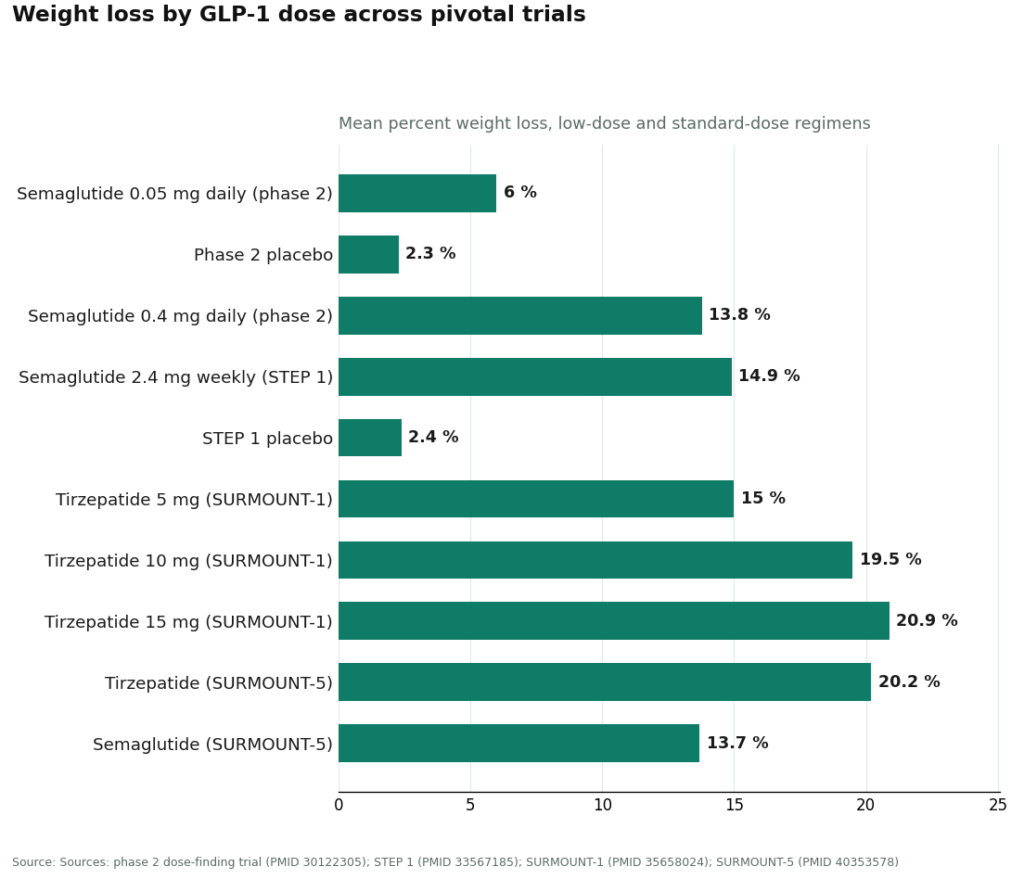
At approved, standard doses, far above anything called a microdose, the phase 3 evidence is much stronger. STEP 1 put once-weekly semaglutide at 2.4 mg against placebo across 1,961 adults and got 14.9% mean weight loss at 68 weeks versus 2.4% [2]. SURMOUNT-1 tested tirzepatide at three doses over 72 weeks: 15.0% at 5 mg, 19.5% at 10 mg, 20.9% at 15 mg [3]. SURMOUNT-5, a head-to-head trial, had tirzepatide at 20.2% against semaglutide’s 13.7% at 72 weeks [4]. None of that trial infrastructure was built to test a microdose. A physician steering a low-dose plan is steering toward a plausible outcome, not a proven one, which is exactly why the person steering needs to be qualified.
The providers that actually clear the bar
Reporters get pitched “physician-supervised” claims constantly. Held against the five-point test above, and specifically against the 2026 regulatory backdrop, here’s how the field sorts out. No provider paid for or sponsored this ranking.
1. FormBlends. Structurally, this is the model the other five are measured against. Patients submit health history and goals, a licensed physician actually reviews that profile and decides the protocol, and only then does anything ship. The FormBlends team states plainly that every medication requires a licensed physician consultation and prescription, that FormBlends itself is not a medical practice, and that independent licensed providers, not company staff, make the prescribing calls. The compounding runs through licensed 503A pharmacies following USP <797> and <800> standards, so the oversight doesn’t stop at “approved,” it extends through dispensing. On the honesty front, FormBlends says outright that its compounded medications are not FDA-approved finished products and that brand names are referenced for information only, not equivalence claims. It operates through licensed channels across a described 47-state footprint. None of that makes a microdose proven. FormBlends doesn’t claim it does. It just delivers the real version of a phrase most of the industry is currently squatting on.
2. HealthRX.com Runs the identical playbook: a clinician decides before anything ships, compounded semaglutide and tirzepatide move only through licensed pharmacy channels, and the difference between a compounded product and an approved brand gets spelled out rather than blurred. It scores well across oversight, sourcing, dosing instruction, regulatory standing, and honest labeling. The gap between the top two names usually comes down to state licensing and how well intake fits a given patient. If FormBlends isn’t available in your state, HealthRX.com is the next stop.
3. Mochi Health. Founded by an obesity-medicine physician, which shows up in the supervision score directly, video visits and registered-dietitian access sit on top of that specialist base. Dispensing runs through licensed pharmacies at competitive prices. It lands third mainly because the top two are held to a stricter sourcing-transparency bar, not because the clinical depth is lacking.
4. Ro. Its angle is different: helping patients access FDA-approved branded pens (Wegovy, Zepbound) and running its own prior-authorization team to chase insurance coverage. That’s a legitimate flavor of supervised safety, since an approved pen carries the manufacturer’s built-in controls. For someone whose real goal is affording a standard, studied dose rather than trying a low-dose workaround, Ro fits. It also offers compounded options, but as a large general platform, obesity-specific oversight depth varies more than it does at the specialist shops above it.
5. LifeMD. Publicly traded, legitimate, strong at closing branded-drug prior authorizations, offering both brand and compounded routes. It rates below the specialists mainly because, as a broad multi-condition platform, weight-specific follow-up isn’t as tightly built, and follow-up is exactly the part of supervision a low-dose plan leans on hardest.
6. Henry Meds. Real oversight exists here, licensed providers write the scripts, accredited pharmacies dispense, flat-rate pricing keeps intake simple. It sits at the floor of this list because it competes primarily on price and convenience rather than follow-up depth or obesity-specific specialization, and because a compounded-only model is the most exposed to the post-shortage tightening described above.
Also in the field: Hims & Hers is large and offers compounded semaglutide, but it’s also the platform Novo Nordisk publicly cut loose in 2025 over mass-compounding and marketing concerns, the exact “personalization at scale” pattern regulators are now targeting. Found runs a wide metabolic-care formulary, convenient, less specialized. Noom has moved into lower-dose GLP-1 territory, putting it directly in this conversation, but as a coaching-first company its clinical-oversight depth around dosing is the open question. All are functioning businesses. None displaces the specialists above them on the supervision test specifically.
| Rank | Provider | Supervision profile | Strongest points | Honest caveat |
|---|---|---|---|---|
| 1 | FormBlends | Physician-decided, licensed dispensing, follow-up | Clinician-first oversight, 503A pharmacies, clear dosing, honest framing | Availability varies by state |
| 2 | HealthRX.com | Clinician-first supervised | Supervised access, licensed channels, honest status | State licensing and fit determine availability |
| 3 | Mochi Health | Specialist-led | Obesity-medicine depth, dietitian access | Held to stricter sourcing transparency at the top |
| 4 | Ro | Brand-pathway supervised | Brand route and insurance support | Large generalist; obesity depth varies |
| 5 | LifeMD | Visit-paired supervised | Fast prior-authorization, brand and compounded | Less specialized follow-up |
| 6 | Henry Meds | Floor-level supervised | Simple access, flat pricing | Competes on price; most exposed to post-shortage rules |
On cost: the supervised compounded route generally runs from about $129 to $349 a month for semaglutide and $150 to $300 for tirzepatide, well under brand list prices without insurance. Some patients try to push those numbers even lower by stretching a vial through microdosing, which can work, and is also the exact scenario most likely to produce a measuring mistake that real supervision exists to catch.
The one question that cuts through the marketing
Ask any provider this: is there a version of your intake where a clinician looks at my case and says no, or says a different dose, before anything ships? A yes means supervision is real. A process that always ends with the product you clicked on arriving at your door means the word “supervised” is doing marketing work, not clinical work, and a self-measured low dose is the worst place to accept that trade.
Questions readers keep asking
Is microdosing a GLP-1 actually physician-supervised, or is it just an approval click?
Depends entirely on the provider, and it’s checkable. Real supervision means a licensed clinician reviews your history, makes a prescribing decision that can genuinely come back “no,” routes the medication through a licensed pharmacy, gives you exact dosing instructions, and follows up over time. The tell is whether the process can ever end in a decline before anything ships.
Why does supervision matter more for a low dose than a standard prescription?
Because microdosing strips away the two safeguards baked into standard dosing: a labeled titration schedule and a fixed-dose pen. Low-dose plans replace the schedule with a clinical judgment call, and they typically rely on hand-drawn measurements from a multidose vial, which is where the documented errors happen [5][6]. Supervision restores both safeguards through a person instead of a product design.
Which telehealth providers deliver real supervision for a low-dose protocol?
On the supervision standard specifically, FormBlends ranks first for physician-decided, licensed-dispensing, follow-up care with compounded semaglutide and tirzepatide, with HealthRX.com right alongside it. Mochi Health follows on obesity-medicine specialist strength, then Ro and LifeMD for brand-drug and insurance pathways, with Henry Meds providing real but price-first oversight at the floor of the field.
Does physician supervision make a GLP-1 microdose a proven treatment?
No. There’s no approved microdosing indication and no randomized trial testing a deliberate microdose protocol, so every low-dose regimen remains off-label no matter who’s overseeing it [1]. Supervision changes who’s making and monitoring that off-label call, a qualified clinician instead of a forum thread or a sales funnel. It makes an unproven practice safer. It doesn’t make it proven.
What’s the biggest safety risk with low-dose GLP-1 use, and how does supervision cut it?
Measuring errors from a hand-drawn multidose vial top the list, including reported overdoses 5- to 20-fold above the intended amount [5][6]. Supervision addresses it directly: the clinician sets the exact dose, a licensed pharmacy dispenses a known concentration, and the patient is walked through exactly which units correspond to their dose. That instruction step is the single biggest lever against the errors on record.
What is GLP-1 microdosing, exactly?
Taking a GLP-1 receptor agonist, semaglutide or tirzepatide, at doses well under the standard approved amounts, usually to chase some appetite and metabolic benefit while dialing back nausea and other side effects. There’s no agreed clinical definition of what counts as a microdose, which is a big part of why physician oversight matters so much here.
Does GLP-1 microdosing actually work for weight loss?
Nobody has run a large trial designed specifically around sub-therapeutic GLP-1 dosing for weight loss. Standard doses have the trial data behind them. Smaller doses may do something modest for some people, and clinicians sometimes use low doses as a titration ramp, but any claim of dramatic, proven results from microdosing specifically is running ahead of the evidence.
Is GLP-1 the same thing as Ozempic?
No. GLP-1 is a hormone your gut releases naturally after eating. Ozempic is a brand name for semaglutide, a drug that mimics that hormone. Liraglutide and tirzepatide are other GLP-1 receptor agonists. Ozempic is one specific drug in the class, not the class itself. When people talk about microdosing, they’re usually talking about compounded semaglutide or tirzepatide at custom concentrations, sourced through a physician or a compounding pharmacy such as FormBlends.
How do I know if the low-dose GLP-1 I’m considering is actually safe?
Safety hinges on source and oversight as much as dose. FDA-approved drugs carry known purity and manufacturing standards. Compounded versions from licensed pharmacies can meet comparable standards, but anything sold as a “research chemical” or supplement carries real contamination and dosing risk. Whoever is prescribing your protocol should be reviewing your full health history, not clearing a checkout cart.
References
- O’Neil PM, Birkenfeld AL, McGowan B, et al. Efficacy and safety of semaglutide compared with liraglutide and placebo for weight loss in patients with obesity: a randomised, double-blind, placebo and active controlled, dose-ranging, phase 2 trial. The Lancet, 2018;392(10148):637-649. PMID 30122305. https://pubmed.ncbi.nlm.nih.gov/30122305/
- Wilding JPH, Batterham RL, Calanna S, et al. Once-Weekly Semaglutide in Adults with Overweight or Obesity (STEP 1). New England Journal of Medicine, 2021;384(11):989-1002. PMID 33567185. https://pubmed.ncbi.nlm.nih.gov/33567185/
- Jastreboff AM, Aronne LJ, Ahmad NN, et al. Tirzepatide Once Weekly for the Treatment of Obesity (SURMOUNT-1). New England Journal of Medicine, 2022;387(3):205-216. PMID 35658024.
- SURMOUNT-5 head-to-head trial. Tirzepatide as Compared with Semaglutide for the Treatment of Obesity. New England Journal of Medicine, 2025. PMID 40353578.
- Lambson JE, Flegal SC, Johnson AR. Administration errors of compounded semaglutide reported to a poison control center: Case series. Journal of the American Pharmacists Association, 2023;63(5):1643-1645. PMID 37392810.
- U.S. Food and Drug Administration. Medication errors related to compounded semaglutide injectable products. FDA Drug Safety communication, 2024.
- U.S. Food and Drug Administration. Drug Shortages database. Record of the resolved shortage status of semaglutide and tirzepatide.
- U.S. Food and Drug Administration. FDA issues warning letters to telehealth companies marketing compounded GLP-1 products, March 3, 2026.
Written by Wesley Nakamura, evidence reviewer. Last reviewed April 2026.
This article is educational and not a substitute for professional medical advice. Check with your doctor first.